Due to nearly killing myself practicing with the junior high first grade tennis students, I'm rather exhausted today. As such, please enjoy this light entry showcasing my Thursday morning elementary school, Shimago.
Near as I can tell, this school's name, and the village it's situated in, translates to "Island Child." Amakusa, by the way, is "Heavenly Grass."
Here's a shot from out front. If you look closely behind the car on the left, you can see a walkway leading from the main building to one of the hallways we'll see later.
Taking a right turn from the entryway leads to the teacher's room. Note that this picture was taken from the other direction, so you'd actually be approaching it from the hall on the right.
Here is the room that makes up the bulk of the central building. It's a large open area where various students' artwork and projects are displayed. To the right are the tanpopo (special needs) class and the library. There is also a room on the left side where announcements are made as well as a storage closet for various things like vacuums. Traveling through the large entryway on the right leads to...
a long hallway where the 3rd through 6th grade classes are held. As I usually teach 5th and 6th grade, I spend most of my time outside the teachers room roaming this hall. This picture was taken from the walkway I pointed out in the earlier picture. And to the left we have...
the gym. Albeit from a completely different angle.
Last is a picture of the lunch room. I was surprised to find that many of my schools had these, as it was my understanding that most Japanese students ate in their homerooms. The 1st and 2nd grade hall is behind the lunchroom and the teacher's room is back and to the right.
Hope you've enjoyed this tour of my school. No doubt there will be others to come. Don't worry if you were confused by the layout of this school, it's by far the most complicated. Heck, tomorrow's is practically one long hallway, but I'm getting ahead of myself.
Thursday, June 10, 2010
Wednesday, June 9, 2010
Japanese License Adventure Part I: The Testing
I remember when I got my license in America. I traveled down to the tiny DMV in Seguin, a mere 40 minutes from home, with my sister. I took a short written test and a road test through the surrounding area and received my license the same day. Yeah, today was nothing like that.
Welcome to the Kumamoto Prefectural Drivers License Center. Just a pleasant 3 hour drive from Ariake. The first thing you may notice is that it's freakishly huge.
Now granted, I went to a rather small town to get my license in America, but this seems a bit lofty for a place that deals solely with processing licenses.
It even has its own diner and newsstand. I bought this week's Shonen Jump here.
The diner had machines inside where you bought tickets for the food you wanted, than handed them to the people who worked in the kitchen. I've been to a few places like this before, but I'll admit it took me a while to get everything sorted out.
Enough about the lavish accommodations, though. I came here to get my Japanese license, and to do that I had to go through several steps. The tests themselves were fairly standard, save one. There was a ten question true/false written test that was laughably easy compared to its American counterpart, an eye test, a road test, and an interview. Yes, in order to get your license in Japan, you may be required to answer such questions as "What was the displacement of the vehicle you drove to obtain your license in America?" and "How many days and hours did you practice driving prior to obtaining your license?" I did the best I could with the questions and they were actually quite forgiving with the ones I didn't know. That just left the practical road test, which I had been dreading the most.
The practical road test is performed on a closed course behind the center. It is incredibly demanding and I've heard of people failing for forgetting to check behind them on a single turn. Due to my over-correcting on this point and checking ALL of my mirrors for every minor turn and lane change, coupled with touching the curb on the S-turn, I failed. Not how I wanted the day to end, but not surprising either. Most people take 2 or 3 tries before they get it right. I've heard it took my predecessor 7. I hope to do it in fewer. Rest assured, when I do, you'll hear about it.
Welcome to the Kumamoto Prefectural Drivers License Center. Just a pleasant 3 hour drive from Ariake. The first thing you may notice is that it's freakishly huge.
Now granted, I went to a rather small town to get my license in America, but this seems a bit lofty for a place that deals solely with processing licenses.
It even has its own diner and newsstand. I bought this week's Shonen Jump here.
The diner had machines inside where you bought tickets for the food you wanted, than handed them to the people who worked in the kitchen. I've been to a few places like this before, but I'll admit it took me a while to get everything sorted out.
Enough about the lavish accommodations, though. I came here to get my Japanese license, and to do that I had to go through several steps. The tests themselves were fairly standard, save one. There was a ten question true/false written test that was laughably easy compared to its American counterpart, an eye test, a road test, and an interview. Yes, in order to get your license in Japan, you may be required to answer such questions as "What was the displacement of the vehicle you drove to obtain your license in America?" and "How many days and hours did you practice driving prior to obtaining your license?" I did the best I could with the questions and they were actually quite forgiving with the ones I didn't know. That just left the practical road test, which I had been dreading the most.
The practical road test is performed on a closed course behind the center. It is incredibly demanding and I've heard of people failing for forgetting to check behind them on a single turn. Due to my over-correcting on this point and checking ALL of my mirrors for every minor turn and lane change, coupled with touching the curb on the S-turn, I failed. Not how I wanted the day to end, but not surprising either. Most people take 2 or 3 tries before they get it right. I've heard it took my predecessor 7. I hope to do it in fewer. Rest assured, when I do, you'll hear about it.
Tuesday, June 8, 2010
Come for the Teaching, Stay for the Agriculture
Another fun surprise was waiting for me at elementary school today. A number of boxes with plants in them and some wheelbarrows were all lined up in front of the school.
Hmmm...I wonder where the kids are running off to?
Down the rabbit hole...
and into the secret garden!
Yes, today was planting day for my students' garden. Each of the boxes out front had a number that corresponded with the planting teams.
Little white signs were placed on the end of each row to show which team was responsible for maintaining it. First things first, let's collect rocks!
Here's the bucket I helped with:
All the rocks were dumped under a nearby tree.
After receiving some instructions from the students' grandparents (who were on hand to help if we needed it) everyone set about spacing out the plants.
Next came the actual planting. We were told to bury them up to the fourth branch and pat down the soil afterward.
Last, we watered the plants. Each one got ten handfuls of water. An excellent opportunity to practice counting in English if you ask me.
Here's the sign for our "Waku Waku Noen" or "Exciting Agricultural Garden." In faded letters below, it says "joy to grow" and "beware of snakes." Nice!
It certainly was a day I won't soon forget.
Monday, June 7, 2010
Class Report: How Are You?
Due to a conflict with my upcoming Japanese driving test, the elementary school that I usually go to on Wednesday had me come in and teach today. I’m really glad they did, too. I don’t want a week to go by without teaching these kids if I can help it. Today was all about greeting friends and talking about our feelings. We had been practicing similar things for a few weeks and so this class served mostly to wrap up the unit and give the kids another day of practice.
We started off the class by playing sound clips of two pairs of people greeting each other. The students had to choose which picture in their book matched with which clip. The biggest difference between the two clips was the way in which the pair introduced themselves. The first pair was meeting for the first time and introduced themselves to each other. The second pair were friends and simply said hello to one another. We checked to see if the students understood and explained that when you know the person you’re talking to, it’s okay to just say hello followed by their name. I practiced with my kids, the first few returning my greeting with blank stares. Finally, I approached one of my genki (energetic) girls.
“Hello, Sena,” I said.
“Hello, Eric sensei.”
The pattern established, we started the first of three activities for the day. It was called the line game and was somewhat like the telephone game I used to play as a kid. In it, students turned to the person behind them, greeted them, and asked how they were. Once they were finished, the next person in line turned to the person behind them and so on until the end of the row. The last person in each row had to run to the front and greet the first person and then sit back down in their seat. The winner was the line that could finish fastest. There were a few students absent today, but with a few adjustments (including my participation) we were able to fill in the empty spots. I was seated next to a student named Moeka, who was just about the most adorable thing ever during this game. Her group came in second both times, and each time she let out an emphatic “Yay!” accompanied by a wonderful smile. It made me doubly happy the second time as I was on her team and got to share in the moment.
The next activity was conversation practice where the students walked around the room and greeted each other while filling out a chart in their books. The chart had room for six names and spaces to show if that person felt fine, happy, hungry, or sleepy. As all my kids in this class have name cards in English, I asked that they try and write their friends’ names using capital letters. At this point, the students have had little if any practice with writing English, but I was happy to see that they all tried and was really impressed when a few remembered how to write the names without relying on the name cards. Not having a chart of my own, I took a hands-off approach to this activity, simply walking around to make sure everyone was practicing in English and helping anyone who was having trouble.
The last game was only meant to be a time filler if the class happened to finish early, but ended up being a real hit with some of my kids. We had them all push their desks to the back of the room, pair up, and play rock, paper, scissors. The winners all formed a small circle and the losers formed a larger circle around it. We played the hello song and had the two circles march in opposite directions. I didn’t tell them to, but most students also sang along, which made me happy. When the song finished, the two groups faced each other and greeted the person in front of them. We played three times, and then class was over. A few of the students wanted to play again, most notably Moeka, who was very vocal about it, but we told them there wasn’t enough time and maybe we could play again next week. Stay tuned to find out if we do.
We started off the class by playing sound clips of two pairs of people greeting each other. The students had to choose which picture in their book matched with which clip. The biggest difference between the two clips was the way in which the pair introduced themselves. The first pair was meeting for the first time and introduced themselves to each other. The second pair were friends and simply said hello to one another. We checked to see if the students understood and explained that when you know the person you’re talking to, it’s okay to just say hello followed by their name. I practiced with my kids, the first few returning my greeting with blank stares. Finally, I approached one of my genki (energetic) girls.
“Hello, Sena,” I said.
“Hello, Eric sensei.”
The pattern established, we started the first of three activities for the day. It was called the line game and was somewhat like the telephone game I used to play as a kid. In it, students turned to the person behind them, greeted them, and asked how they were. Once they were finished, the next person in line turned to the person behind them and so on until the end of the row. The last person in each row had to run to the front and greet the first person and then sit back down in their seat. The winner was the line that could finish fastest. There were a few students absent today, but with a few adjustments (including my participation) we were able to fill in the empty spots. I was seated next to a student named Moeka, who was just about the most adorable thing ever during this game. Her group came in second both times, and each time she let out an emphatic “Yay!” accompanied by a wonderful smile. It made me doubly happy the second time as I was on her team and got to share in the moment.
The next activity was conversation practice where the students walked around the room and greeted each other while filling out a chart in their books. The chart had room for six names and spaces to show if that person felt fine, happy, hungry, or sleepy. As all my kids in this class have name cards in English, I asked that they try and write their friends’ names using capital letters. At this point, the students have had little if any practice with writing English, but I was happy to see that they all tried and was really impressed when a few remembered how to write the names without relying on the name cards. Not having a chart of my own, I took a hands-off approach to this activity, simply walking around to make sure everyone was practicing in English and helping anyone who was having trouble.
The last game was only meant to be a time filler if the class happened to finish early, but ended up being a real hit with some of my kids. We had them all push their desks to the back of the room, pair up, and play rock, paper, scissors. The winners all formed a small circle and the losers formed a larger circle around it. We played the hello song and had the two circles march in opposite directions. I didn’t tell them to, but most students also sang along, which made me happy. When the song finished, the two groups faced each other and greeted the person in front of them. We played three times, and then class was over. A few of the students wanted to play again, most notably Moeka, who was very vocal about it, but we told them there wasn’t enough time and maybe we could play again next week. Stay tuned to find out if we do.
Friday, June 4, 2010
To the Bookmobile!
There was a surprise waiting in front of the elementary school a few weeks ago:
It may be difficult to tell, but this is a mobile library. Here it is from another angle:
The kanji on the roof is backwards from this point of view, but it says “天草市立図書館” which translates to “Amakusa City’s Library.” From what I was able to gather, it visits the school about once a month, though this is the first time I’ve seen it anywhere.
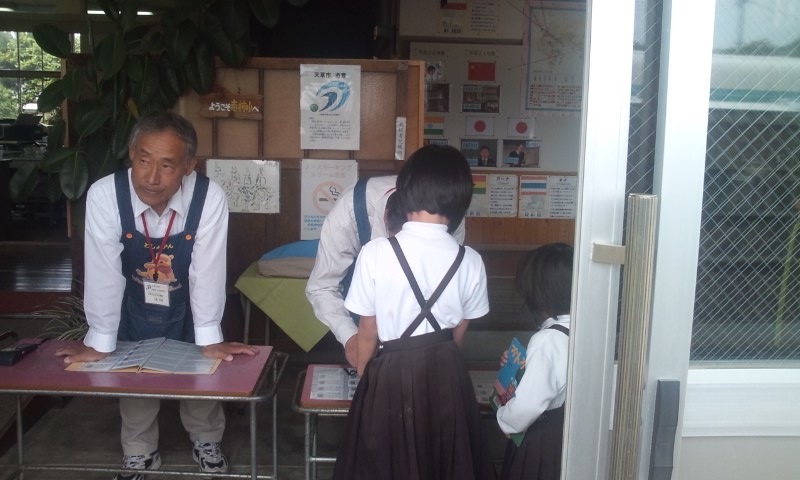
Here are some of the books my fifth and sixth graders were looking at. It seems the van was organized so that as you moved around it from the passenger side (which is on the left in Japan) the books got progressively more difficult. There were also some crates lining the walkway out front that were filled with picture books for the youngest kids.
These two gentlemen were the librarians/drivers and carried with them folders that were filled with library cards for all the students. The students would come up and say their grade level and name. Their cards would be scanned followed by the books they had chosen. Each student was allowed to borrow five books. This turned out to be a great way to have my 1st and 2nd graders practice telling me how many books they had, which happened to be their lesson for that day. I was very pleased to see that many of them were borrowing the maximum amount.
It may be difficult to tell, but this is a mobile library. Here it is from another angle:
The kanji on the roof is backwards from this point of view, but it says “天草市立図書館” which translates to “Amakusa City’s Library.” From what I was able to gather, it visits the school about once a month, though this is the first time I’ve seen it anywhere.
Here are some of the books my fifth and sixth graders were looking at. It seems the van was organized so that as you moved around it from the passenger side (which is on the left in Japan) the books got progressively more difficult. There were also some crates lining the walkway out front that were filled with picture books for the youngest kids.
These two gentlemen were the librarians/drivers and carried with them folders that were filled with library cards for all the students. The students would come up and say their grade level and name. Their cards would be scanned followed by the books they had chosen. Each student was allowed to borrow five books. This turned out to be a great way to have my 1st and 2nd graders practice telling me how many books they had, which happened to be their lesson for that day. I was very pleased to see that many of them were borrowing the maximum amount.
Class Report: Nantoka Basket
There is a truly amazing game in Japan called fruit basket. In it, kids choose some fruit names, usually about four but it depends on the group size. Each student is assigned one fruit and sits in a circle, with one student standing in the middle. The student in the middle calls out a fruit or two and everyone in the circle assigned that fruit runs around trying to get to an empty spot before someone else does. It’s kind of like musical chairs in a way. Naturally, there is always one kid left standing and they take the place of the person in the middle. The person in the middle can also call out “fruit basket” to make everyone change places. Why is this an awesome game? Because it’s perfect for teaching English, of course, as yesterday’s fifth grade elementary class proved.
Now this is not the first time I’ve used this game to reinforce new vocabulary. However, it may be the first time the entire period was spent playing it. Children in Japan love this game, and even those who don’t normally enjoy English class will laugh and scream as they run around, trying to beat their classmate to that last remaining spot. For yesterday’s class, we played “color basket” and “animal basket” but there were a few twists to our games. The first was that we had learned so many colors and animals and have such a small class (only 7 kids) that only assigning them one of each wouldn’t work. Instead, my kids were given slips of paper with two colors for the first game and a whopping four animals for the second. The next rule change was the punishment game. When a student was stuck in the middle for a second time, they had to give an introduction to the class including their name, age, favorite color, and favorite animal. Lastly, before saying the color or animal, all the kids in the circle had to ask “What color/animal do you like?” and the response had to be “I like ______.”
Both games went really well. I joined in naturally and spent a few rounds in the center, though I wasn’t asked to give an introduction. The only other person who avoided the punishment game was Mei, who did so by pure speed and reflexes. She only wound up in the middle once, and then only because she forgot okami was wolf. Her delayed reaction was priceless. I think the kids are pretty comfortable now, not only with the vocab, but also with the target sentences for asking and telling what things they like. These are really important because they are the student’s first steps in being able to have a conversation in English.
As I said, fruit basket is a really versatile game. I’ve used it for months, sports, days of the week, and many other lessons. Sometimes the questions and responses don’t quite match up, like when the kids answered multiple months for the question “when is your birthday?” but the important thing is that they’re practicing English in a fun and engaging way.
Now this is not the first time I’ve used this game to reinforce new vocabulary. However, it may be the first time the entire period was spent playing it. Children in Japan love this game, and even those who don’t normally enjoy English class will laugh and scream as they run around, trying to beat their classmate to that last remaining spot. For yesterday’s class, we played “color basket” and “animal basket” but there were a few twists to our games. The first was that we had learned so many colors and animals and have such a small class (only 7 kids) that only assigning them one of each wouldn’t work. Instead, my kids were given slips of paper with two colors for the first game and a whopping four animals for the second. The next rule change was the punishment game. When a student was stuck in the middle for a second time, they had to give an introduction to the class including their name, age, favorite color, and favorite animal. Lastly, before saying the color or animal, all the kids in the circle had to ask “What color/animal do you like?” and the response had to be “I like ______.”
Both games went really well. I joined in naturally and spent a few rounds in the center, though I wasn’t asked to give an introduction. The only other person who avoided the punishment game was Mei, who did so by pure speed and reflexes. She only wound up in the middle once, and then only because she forgot okami was wolf. Her delayed reaction was priceless. I think the kids are pretty comfortable now, not only with the vocab, but also with the target sentences for asking and telling what things they like. These are really important because they are the student’s first steps in being able to have a conversation in English.
As I said, fruit basket is a really versatile game. I’ve used it for months, sports, days of the week, and many other lessons. Sometimes the questions and responses don’t quite match up, like when the kids answered multiple months for the question “when is your birthday?” but the important thing is that they’re practicing English in a fun and engaging way.
Thursday, June 3, 2010
Class Report: Gestures
Here in Japan, the school year is still in its first few months. My elementary fifth graders are still being introduced to only the most basic English expressions. In fact, yesterday’s lesson wasn’t really about English at all, but non-verbal communication. In elementary, the focus in English class is on communication, as opposed to junior high, which is focused on mastery of grammar. This is part of what makes the elementary classes so fun. There is just a lot more interaction with the students, more doing as opposed to showing.
The gesture class basically breaks down into three parts. For the first, the homeroom teacher and I had the students make groups of four. One person in each group would make a gesture while the other three tried to guess what it was. We let them know that Japanese was okay, but I was pleasantly surprised to find a few of my students trying to guess in English. We had each student do two gestures and then the game was over. After the groups were finished, I asked for volunteers to show their gesture in front of the whole class. Honestly, asking for volunteers at that age is hit or miss. Again, I was happy to see at least one student was excited about the idea. Riko, one of my more energetic girls, showed us a gesture for swimming. I asked if anyone else wanted to go, and when the response was still a room full of blank stares, we decided to have each group choose one volunteer. Most did this by playing janken (rock, paper, scissors), with the losers being the ones who demonstrated their gestures. There were some pretty good ones too, like playing the recorder and table tennis, which was done with two students. After each group had a turn, I thought there might be some students who were feeling a little more at ease with the idea, so I asked for volunteers again. Riko’s hand shot up, but she was still the only one. She was so excited about it, though, so we had her do a second one.
The next part of class was a short skit by the homeroom teacher (HRT) and me. It was meant to show the differences between American gestures and Japanese ones.
Me: “Sensei!”
HRT: “Me?”
Me: “Yes. Please come here.”
HRT: “What is it?”
Me: “How are you?”
HRT: “Me? I’m fine. How are you?”
Me: “I’m very happy.”
Throughout the skit, I used only American gestures, and my HRT only Japanese ones. We performed the skit twice then asked the students if they noticed any differences between what we did. One girl, Rino, was able to pick up one the differences in how we indicated ourselves. For those who don't know, in Japan this is done by pointing your forefinger toward your nose. We went on to explain the differences between the gestures for calling someone over and how the Japanese version may be confused in America for the exact opposite, leading to another humorous skit in which the HRT used the Japanese gesture and I walked away sadly.
To finish, we had the students try and combine everything they’ve learned up to this point to have short conversations in pairs. The HRT and I demonstrated and reviewed some target sentences with the students. They could call each other over, introduce themselves, and ask how the other student was doing. We only had about five minutes at this point, but it was great seeing the kids interacting with each other. I joined in too and though the students who talked to me were clearly nervous, they did really well. I was very happy with how this lesson went.
The gesture class basically breaks down into three parts. For the first, the homeroom teacher and I had the students make groups of four. One person in each group would make a gesture while the other three tried to guess what it was. We let them know that Japanese was okay, but I was pleasantly surprised to find a few of my students trying to guess in English. We had each student do two gestures and then the game was over. After the groups were finished, I asked for volunteers to show their gesture in front of the whole class. Honestly, asking for volunteers at that age is hit or miss. Again, I was happy to see at least one student was excited about the idea. Riko, one of my more energetic girls, showed us a gesture for swimming. I asked if anyone else wanted to go, and when the response was still a room full of blank stares, we decided to have each group choose one volunteer. Most did this by playing janken (rock, paper, scissors), with the losers being the ones who demonstrated their gestures. There were some pretty good ones too, like playing the recorder and table tennis, which was done with two students. After each group had a turn, I thought there might be some students who were feeling a little more at ease with the idea, so I asked for volunteers again. Riko’s hand shot up, but she was still the only one. She was so excited about it, though, so we had her do a second one.
The next part of class was a short skit by the homeroom teacher (HRT) and me. It was meant to show the differences between American gestures and Japanese ones.
Me: “Sensei!”
HRT: “Me?”
Me: “Yes. Please come here.”
HRT: “What is it?”
Me: “How are you?”
HRT: “Me? I’m fine. How are you?”
Me: “I’m very happy.”
Throughout the skit, I used only American gestures, and my HRT only Japanese ones. We performed the skit twice then asked the students if they noticed any differences between what we did. One girl, Rino, was able to pick up one the differences in how we indicated ourselves. For those who don't know, in Japan this is done by pointing your forefinger toward your nose. We went on to explain the differences between the gestures for calling someone over and how the Japanese version may be confused in America for the exact opposite, leading to another humorous skit in which the HRT used the Japanese gesture and I walked away sadly.
To finish, we had the students try and combine everything they’ve learned up to this point to have short conversations in pairs. The HRT and I demonstrated and reviewed some target sentences with the students. They could call each other over, introduce themselves, and ask how the other student was doing. We only had about five minutes at this point, but it was great seeing the kids interacting with each other. I joined in too and though the students who talked to me were clearly nervous, they did really well. I was very happy with how this lesson went.
Subscribe to:
Posts (Atom)