Showing posts with label Weekend Review. Show all posts

Thursday, May 10, 2012

mAyKB48 (10/48): Review- Majisuka Gakuen

Majisuka Gakuen / Japanese TV Series Majisuka Gakuen (Are You Serious? Academy) was a late night television series that originally aired January through March of 2010 on TV Tokyo. Spanning 12 episodes, it featured a cast comprised primarily of AKB48 members, with a few of the more popular girls from SKE48 and a handful of established actors rounding out the cast. As most girls used either their real names or nicknames derived from their interests or personalities, this series can be looked upon as yet another vehicle used to promote these idols outside of music.

The story follows Maeda Atsuko, a transfer student to Majisuka Gakuen, an all-girls academy where fighting is commonplace and students do as they please. Though initially appearing quiet and studious, Atsuko's true nature arises anytime someone asks "Are you serious?" After single-handedly beating a gang known as Team Hormon, Atsuko captures the attention of Rappapa, the most powerful and influential group on campus. What follows is a series of battles to the top, with Atsuko learning about friendship and facing the demons of her past along the way.

Majisuka Gakuen is not for everyone. It may not even be for all AKB48 fans. It suffers from a number of problems, mostly to due with the relative inexperience of AKB48 members in acting roles. Our protagonist Atsuko spends the majority of each episode sitting and speaking very quietly or doing chores at the nearby hospital (she wants to be a nurse.) It is not a challenging role and can be very boring at times. Her best friend Onizuka Daruma, portrayed by SDN48's Nachu, has the opposite problem as she speaks at length in an annoying accent. Meant to be the comedy relief of the series, Daruma only manages to come off as anything more than a nuisance in a handful of scenes. Rounding out the main cast is Atsuko's crew, which quickly forms from her defeated rivals in the first few episodes. Most of them deliver solid performances, though several tend to overblow the tough girl act. A few of the remaining performances stand out and most are passable, but several are either flat or ridiculously over the top.

Hope you like vacant expressions.
Another area that falls flat is the plot. To be perfectly honest, so much slang is used in this series that I have trouble understanding what is going on at times, and thus I miss some of the more subtle nuances. Even so, the series hits a peak too soon in terms of action and the last handful of episodes feel more like going through the motions than building up to a satisfying climax. Also, there is a point about two-thirds of the way through where we suddenly have magic. No explanation, just all of a sudden there are characters that move at super speed or read your memories by touching you. This isn't really a problem, I just wish some sort of explanation or lead in was given beforehand.

And no, I wouldn't really count this as a spoiler.
As a late night series, Majisuka Gakuen had more leeway with depictions of violence, and really it's the fights that were the main draw for me initially. I do feel the battles in this series suffered a bit by not having actors accustomed to fight choreography. Fights are often spliced together from several quick shots, making figuring out what exactly is happening difficult. Slow motion is used a number of times, leading to the feeling that punches aren't hitting with any kind of force.


Still, watching high school girls beat the crap out of each other is the kind of schlock that can make me overlook other negative aspects of the show. In much the same way that the Kamen Rider or Super Sentai series can have me coming back week after week just to see the giant monster fight in the last third of the show, Majisuka Gakuen kept me interested enough to see what new opponent Atsuko and her crew would have to beat down next. A lot of the fighters also had quirky gimmicks or habits that prevented the series from slipping into monotony.

Returning to the acting for just a moment, I'd like to highlight a few of the performances that I think are the best of the bunch.


First off, Oshima Yuko does a great job with her character. She plays the leader of Rappapa, who is slowly dying from some degenerative disease that I'm not sure is ever fully explained. This is a demanding role and a character who is honestly far more interesting than the protagonist. Yuko switches from elation to anger to deep sadness and does it all convincingly. With her thoughts frequently turning to the glory of her past, Yuko makes a nice foil to Atsuko. But where Atsuko forces down all her emotion, and thus becomes a stoic, emotionless girl, Yuko decides to live life to the fullest with the time she has left. When this is no longer an option, the pain and sadness she goes through is palpable and very well handled. This likely has to do with the fact that Yuko came into this role with the most acting experience, being a child actor before joining AKB.


I also feel Watanabe Mayu does a great job as the treacherous Nezumi. She has a small role throughout most of the series, but she manages to walk the thin line between adorable and creepy quite well. The sequel bait at the end of the series suggests she will have a larger role to play in the second season, which I have not yet seen.


But the single best performance has to go to Matsui Rena, who plays the completely psychotic Gekikara. She is the sole reason I feel Majisuka Gakuen hits a high point too soon. Episode 8 is the single most brutal and unnerving episode in the entire series. Gekikara's plan is to systematically beat all of Atsuko's friends to within an inch of their lives in an effort to make her angry. She tortures and displays her victims' bodies like trophies, taking and destroying their signature items to add insult to injury.

It is the one time where I felt like the fighting looks authentic. It is not stylized or overly choreographed, it is just a drawn out punching match against an opponent who loves violence. Also, Rena's performance is nightmare-inducing. I have no idea if she's had any acting experience beforehand, but she does an amazing job. Enjoy this clip:


If you're not already a fan of AKB, I'd highly recommend giving this series a pass until you familiarize yourself with the various members. Part of the series charm is seeing your favorite 推しメン in a role outside of the stage performances. For fledgling fans, there  are shows that give a better glimpse into the personalities and interests of AKB members. I'd recommend variety shows like AKBingo or Suiensa to get started. Still, if you want to watch these girls do something a little different or if you are a fan of the yankee high school genre, it may be worthwhile to at least give the series a look. I can't guarantee that you'll like it, but it has its moments. File this one under guilty pleasure.

Obligatory Sae picture!

Wednesday, April 25, 2012

Review: Machine Robo NEXT Magnum Police

I'm no stranger to the Mugenbine toy line, having snatched up most of the figures released during my time in Japan. I talked briefly about the history of Mugenbines in my Needle Stego review but feel it's worth mentioning again. The predecessor to Mugenbines was the Machine Robo series (AKA Gobots). In fact the first Mugenbine, Air Leon, made a brief appearance in the Machine Robo Rescue anime that aired from 2003-2004:


Since his introduction, it seems the Mugenbine line shifted focus from vehicle based robots to primarily animal based ones. Everything I collected while in Japan has an animal mode. And while Needle Stego and Mugen Police have vehicle alt modes, more recent sets have done away with them entirely.

Enter Magnum Police, the newest release from Bandai. The company seems to have dropped the title Mugenbine in favor of Machine Robo NEXT, perhaps to reflect a change of direction back to vehicle themed toys. Make no mistake, however, this toy still looks and plays like any recent Mugenbine candy toy release.


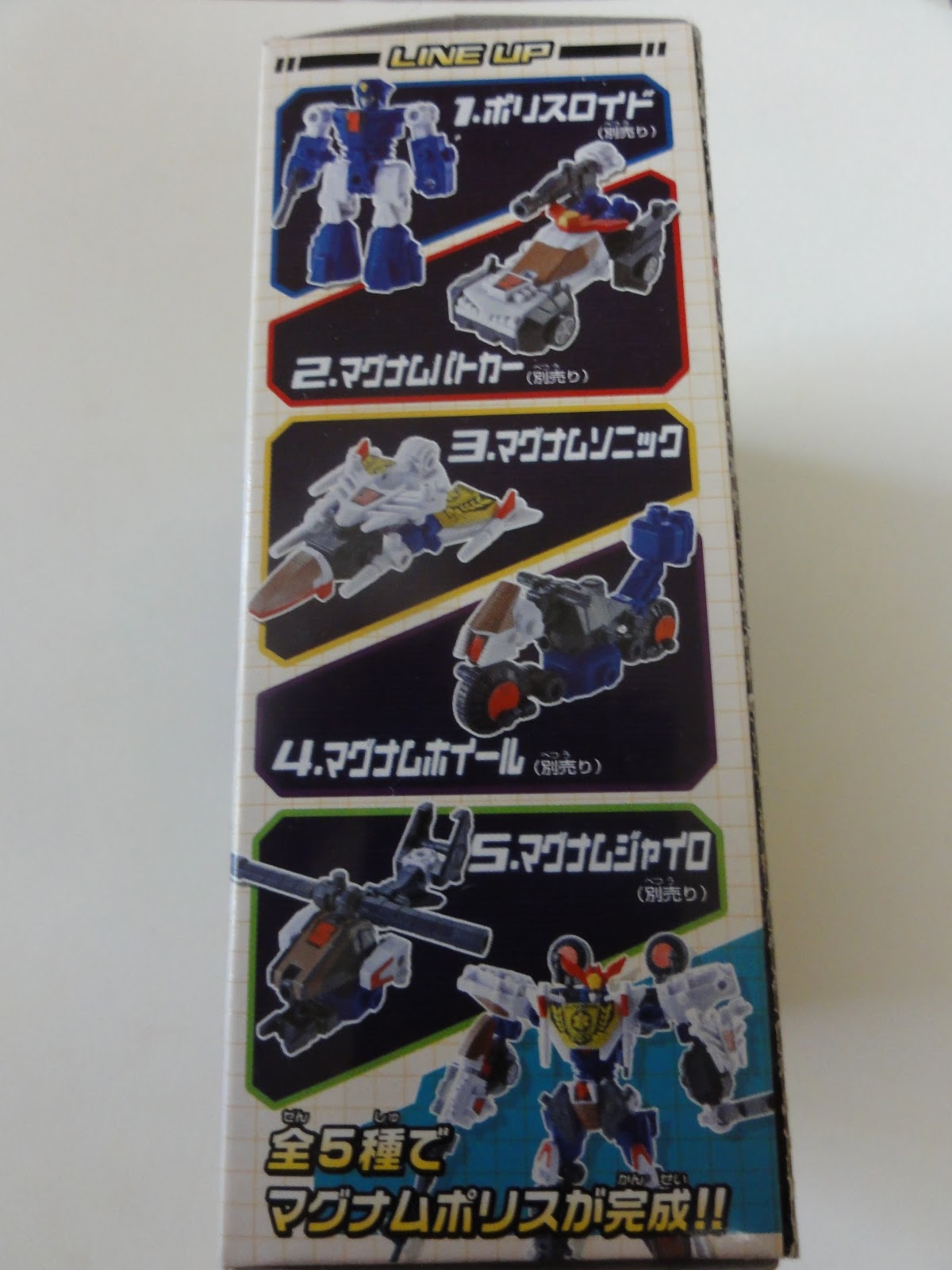
There are five toys in this set: Policeroid, Magnum Patrol Car, Magnum Sonic, Magnum Wheel, and Magnum Gyro. Each comes in a standard candy toy box with pictures of the other toys in the series along one side and a picture of the standard combination on the back in addition to some other possible configurations. In fact, the box encourages you to buy four sets of robots 2-5 in order to make a slew of alternate combinations. Bandai is really pushing the potential play value of these toys, which is great. Still, I opted to only get one set and built the standard combined form. I've only got so much cash. So, lets look at each toy in order.


First up is Policeroid. Out of the box there isn't a lot to assemble. Sticker apps are also thankfully sparse, though I'll comment a bit more on that later. As always, the instructions for the individual machines are on the inside face of the box, which tears open quite nicely, while a copy of the instructions for the combined form is placed inside each box. 


Of note with this release is the inclusion of additional instructions for creating arms and legs from any vehicle with the exception of Policeroid, which always forms the torso. This is what allows you to form all the alternate combined modes and even allows for a bit of customization with a standard set of five.


Back to Policeroid:


Policeroid is a bit blocky, but he has a certain style that I appreciate. I think it's mostly the hat and sunglasses.


I also like the inclusion of the tiny gun with this toy.

Pew, pew!

The new joint system took a little bit of getting used to, but it allows for a good range of motion with the arms even at this small a scale.


I also have to say that this set did a better job overall at hiding all those extra fists and heads that I found distracting in earlier Mugenbine releases. Here you can see the head of Magnum Police placed snugly in the back of Policeroid:


Magnum Patrol Car (I'm honestly guessing at that name, the kana is マグナムパトカー) is probably my least favorite in this set.


I have a serious dislike of the brown used for the window here. Sticker apps in general feel like a misstep with this series, which had recently done away with them entirely and still looked decent. I also hate toy cars with wheels that don't move. Still, not everything on this toy is terrible.


I definitely dig the front of the car. It is probably the most intricately molded piece in the whole set with the exception of maybe some of the face pieces. Also, despite my displeasure with sticker apps, I like the design choice of having a number displayed on each vehicle.


For what it's worth, the sticker for the tires add a cartoony feel to the toy that I feel is appropriate. Still, I wish they could actually roll somehow.


Magnum Sonic is a pretty neat looking jet. It has a pretty clever method of joining the front and back pieces together.


The terrible brown color is present here again, but it doesn't bother me near as much here as it does elsewhere.


Here's a bit of detail on the wings. The red fins were the hardest stickers to apply and I know they'll be the first to start peeling off. The pieces that will form the chest plate of Magnum Police also have awkward sticker apps, though they're mostly flat and thus likely to last longer. You can also see the toy's number sticker located on the tail fin.


Again, the extraneous piece, this time a fist, is cleverly hidden beneath the tail fin and out of sight from most angles.


Magnum Wheel has me torn over whether or not I like it. 


From one side it looks pretty solid.


I like the color in the wheels and the simple design. But from the other side, it is a disaster.


The tires have absolutely no detail from this side. And is that a robot face?


With all the care given to the other toys, it's a shame to see this one fall so flat. Granted it's only three pieces, but at this scale that's nearly half of the overall toy. There are some positives, however, chief among them the ability for Policeroid to ride the motorcycle (with a bit of limb swapping of course):


I recommend repurposing the gun as a kickstand if you want it to stand on its own.


The toy's number is located on the front. It's probably the hardest number to get to stick properly due to the bend in the middle.


Last is Magnum Gyro, whose name may be a nod to Gyro Robo, the helicopter robot form Machine Robo. 


This is probably my favorite of the bunch.


With the overall darker color scheme, the brown doesn't feel out of place and actually adds to the overall design.


My criticisms of this toy are minor and unsurprising. The blades of the helicopter can move, but don't spin freely. The lower part of the helicopter seems unnecessary, but it may represent a weapon of some sort.


Hidden robot face!


As always the big draw, and the purpose of collecting these things,  is the combined form. First, here's what Magnum Police looks like with just the limbs built, before adding all the details from leftover parts. Think of it as an unarmored mode:


It's a bit slimmer than most Mugenbine toys I have, maybe as a result of employing the new joints. It also doesn't have as many extraneous parts, even when you add the rest of the pieces.


Some pieces also form a gun and night stick, allowing Magnum Police to be ready for action:


The final form is pretty cool. Even elements like his backpack, where Bandai usually sticks pieces they can't fit elsewhere, seem to work. He's not overly bulky or awkward and is able to hold a pose pretty well, though I would have liked to see some more articulation down in the ankles. The shield on the left arm also hinders movement a bit, but not so much as to be distracting. The robot face on the side of the gun is also a bit weird, but I almost expect that at this point, especially with a set that has to somehow hide five alternate faces within its design.

This is a pretty standout toy even within the Mugenbine line. It possesses a great deal of play value and is not so cumbersome or ridiculous in its combined form to be difficult to manipulate.  Still, like all the candy toys before it, I feel Magnum Police is better fit for posing than playing, if only because it takes a lot of twisting and turning of pieces to get him looking just right and his joints are rather stiff. Plus, as a combiner you always run the risk that an arm or leg will pop off. 


For now, he'll take up what precious little space is left for him on my nightstand alongside his older cousins:


Let's close things out with the Japanese commercial:

Sunday, March 4, 2012

Weekend Review: Kanji Transformers 3

Today, I'll be taking a look at the third series in a line of transformable kanji toys called moji bakeru (letter transformer) in Japan.


As you can see, this set consists of a lion, elephant, bear, crab, snake, and whale. These are candy toys and can usually be found in supermarkets or even convenience stores for ¥100 (about $1).


Each toy transforms from the kanji that represents the animal into a small figure. I find the concept alone pretty clever and it's a fun way to help remember some simple characters. The color variants for each figure are displayed along the lefthand side of the packaging. The colors have changed from series to series. This one has blue, red, black, or gold. Note that the color of the toy is not displayed on the box so while the toys aren't blind boxed there is still an element of chance and collectibility with them.


Each box contains a sticker sheet, the toy (in kanji form), and a small piece of gum. I've found the flavor of the gum lasts about as long as it takes to apply the stickers.


The transformation and sticker application instructions are printed in black and white on the interior of the box. This is common practice with candy toys. One corner of the packaging is perforated to make unfolding it easier.


I don't want to go into detail regarding every step of the transformations, but I thought I'd illustrate how the process generally breaks down. After disassembling the kanji into smaller sections, you often have to pull pieces apart to reveal the hidden connector pieces inside. These in turn snap into holes or socket joints on other parts of the figure. This allows for quite a few points of articulation for each figure, which is pretty cool given their size. The heads of each figure are usually hidden within one section and are flipped out.


So first off, we have a lion (獅,しし, shishi). Based off the pictures from the packaging, I didn't think I'd like this one, but it's actually pretty nice. I still think the mane is a bit large, but it gives him a cool, almost anime inspired look.


Though I'm not a fan of stickers, I think these toys definitely benefit from having them. I still worry that the wrap around pieces will peel off, but so far they've held pretty nicely, even on my older figures.


The proportions on this one are particularly strange due to what they had to work with for the back legs.


I appreciate the inclusion of the tail here. It was a tiny detail that they probably could have left out without me noticing, but it's neat that it's there.


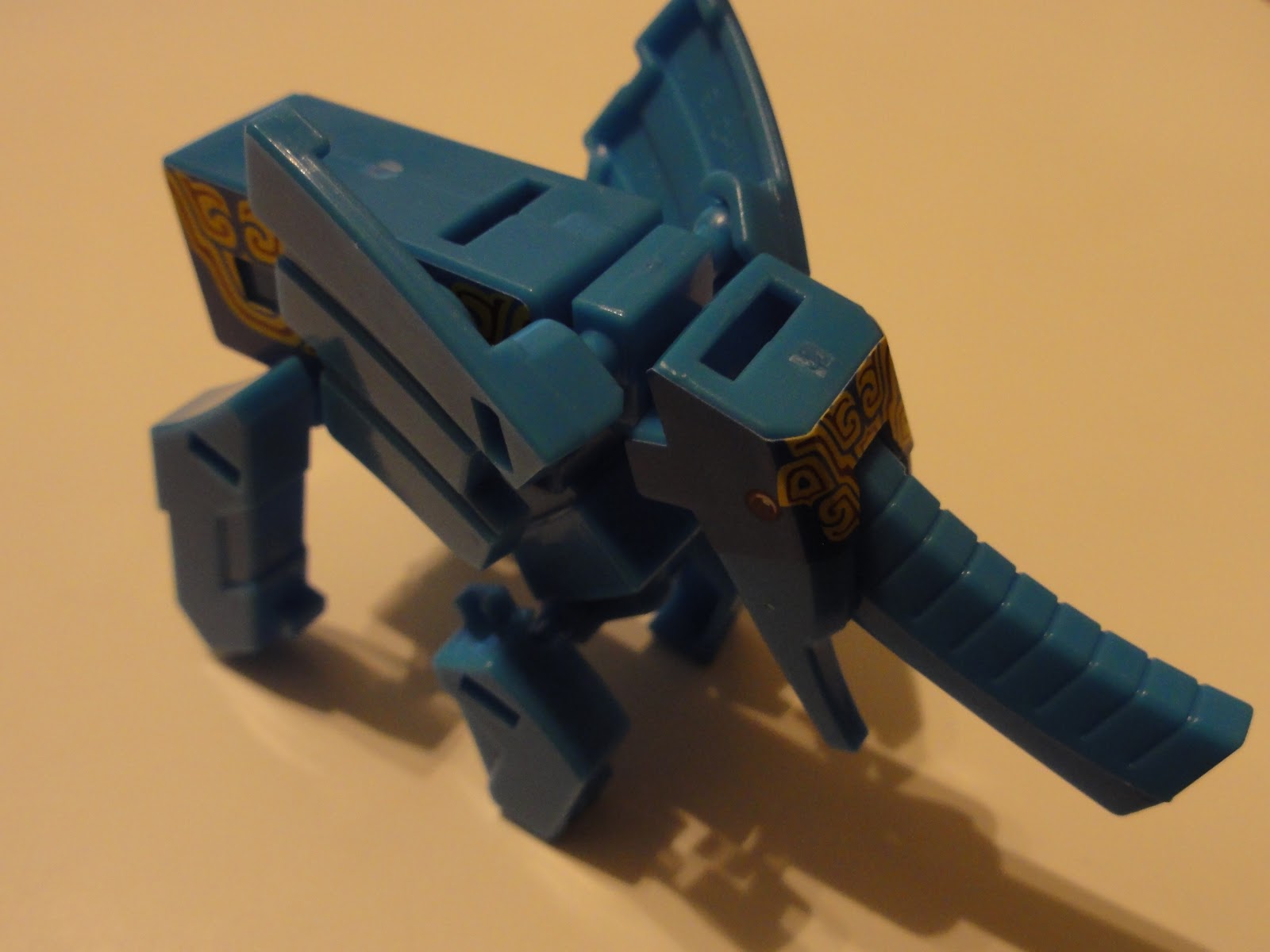
I really like the elephant (象, ぞう, zou). I enjoy how his face and ears are visible in the kanji and enjoy all the mobility present in the figure.


The ears are placed in a socket joint, allowing you to move them around in a wide range of poses. I think it gives it some character. The trunk also has a limited amount of mobility.


Here's a look behind the ears at the main body. I think the front legs are a bit awkward and there's no tail to speak of, but overall it comes off looking a bit better than the lion.


The bear (熊,くま, kuma) naturally holds a special place in my heart as I lived in Kumamoto (熊本) but the figure has a problem in that it is very skinny. I suppose after seeing Kumamon everywhere I just expect a bit more heft in my bears.


This figure is my favorite to pose though because of the range of the arms. I also really enjoy how the element for feet in the kanji become the actual feet of the figure.


Crab (蟹, かに, kani) is actually a fairly complex kanji and this figure in particular has some really cool mechanics with its transformation. The ball joints for the legs fold out in pairs on either side of the body and the claws open and close.


The legs are pretty close together and the claws are attached to the front pair, so it's a little tricky moving everything around at first. Still, the figure lends itself well to posing once you get used to it.


What has two claws and is awesome? This crab!


Next up is the snake (蛇, へび, hebi). He's probably got the simplest transformation of any in this series. As a result, I find him the most middling, though I do appreciate that he's balanced enough to stand on his own in the pose above.


The pieces that make the hood for the figure were really hard to get into the socket joints on the side. These things aren't made with the greatest plastic and I'm always worried I'm going to break something when met with too much resistance.


All the cool sticker apps for this one are on his back so I can't decide which way it would display better.


Last is the whale (鯨, くじら, kujira), which I got in gold. The golden whale is robotic for some reason, which is awesome!


There isn't too much to talk about this figure. He doesn't really move much, but he doesn't need to. He can open and close his mouth though, which is really fun to play with. I like the overall construction of the thing. It's probably my favorite of this series.


Here's a closeup of the tail, which is formed from unfolding the top section of the fish element in the kanji. I really like that part of the transformation.

As I said, this is the third series of kanji transformers. There's a fourth series that I'm still trying to track down as well as a "G" series that I'm currently collecting and will probably discuss soon. These toys are some of my favorites because they are fun, educational, and affordable on any budget. Keep an eye out for them the next time your in Japan.